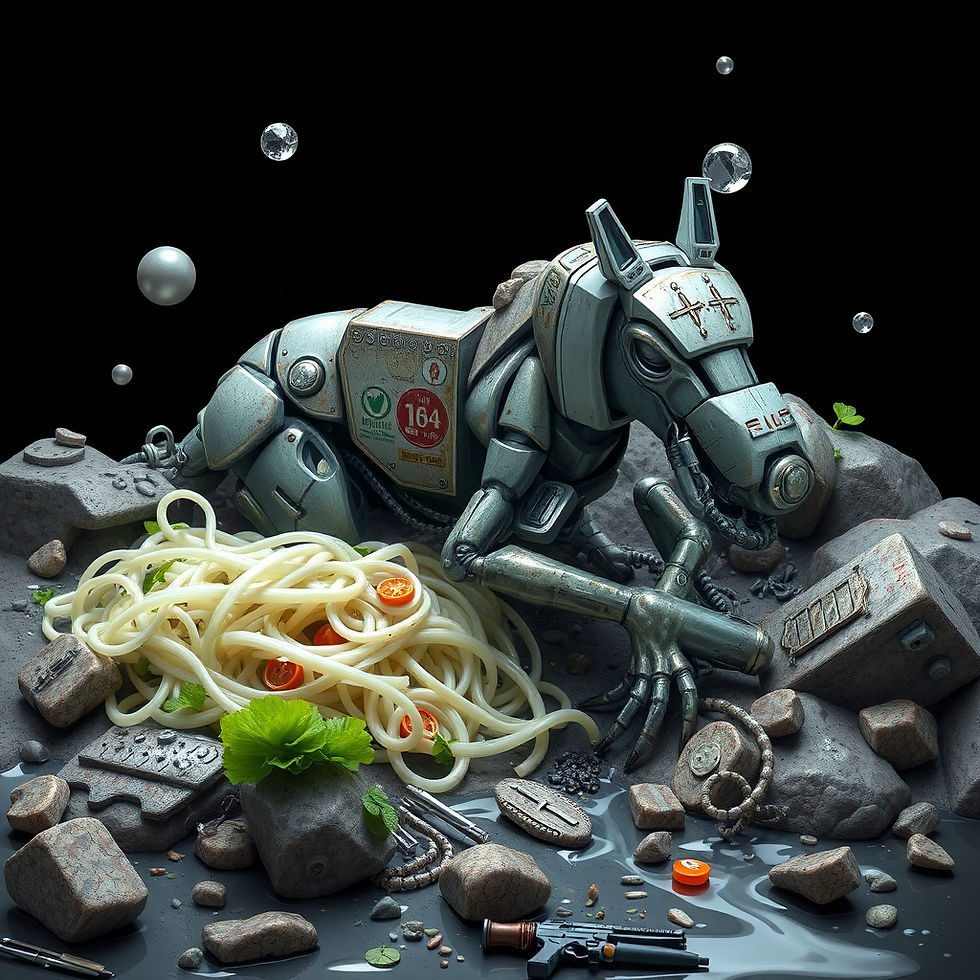
The Glass Horse: What Nolan Gets Right About AI That Your Company Keeps Missing
I saw The Odyssey yesterday. It's a great movie — the kind that reminds you why people still leave the house to sit in the dark with strangers. Nolan shot the whole thing on IMAX film, and it shows. Go see it.
But this isn't a film review. It's about something Nolan said afterward that I haven't been able to shake.
Asked whether AI might be a Trojan horse — a gift you welcome in, only to watch it turn into something darker — he laughed and said, "AI is a Trojan horse that everybody knows the Greeks are inside." Then he added the line that stuck with me: "It's a transparent horse. It's made of glass. Everybody can see what's going on."
Everybody can see. That's the part your company is getting wrong.
The suspicion is not a bug. It's a signal.
Nolan called the public's skepticism of AI "pretty encouraging," especially among young people. He pointed to how quickly a generation coined "AI slop" and shoved the whole thing in a box. His read: this is healthy skepticism, and healthy skepticism is how you get the best out of a new technology instead of blind faith that everything will be fine.
Now hold that thought next to what's happening inside most organizations right now.
The productivity numbers are real. Enterprise data keeps showing measurable gains — faster drafts, quicker code, compressed research cycles. Leadership sees the dashboards move and reads it as a win. Adoption is up. Output is up. Ship it.
Meanwhile, the people doing the work are staring at a glass horse. They can see exactly what's inside. And a lot of them are quietly, deeply uneasy.
So here's my honest question for every company mid-rollout: Are you even bothering to ask your employees how they feel about this?
Not a Slack poll with three emoji reactions. A real one. Anonymous, specific, and safe enough that people tell you the truth.
Output is not the same as buy-in
This is the mistake I keep watching companies make, and it's a classic operating-model error. They confuse a metric that moved with a human that agreed.
Usage went up. Great. But usage under pressure isn't consent — it's compliance. If the message from the top is "use these tools or get left behind," people will use the tools. The dashboard lights up. And you learn nothing about whether they trust what they're producing, whether they understand where it fails, or whether they're quietly cleaning up outputs they don't believe in.
That gap is where the risk lives. A team that adopts AI without trusting it produces confident-looking work nobody actually stands behind. You get speed and fragility at the same time. Anyone who has watched a "successful" launch quietly fall apart in month three knows this pattern.
The gains are showing up. The buy-in might not be. Those are two different measurements, and treating one as proof of the other is how you build something brittle.
You skipped the human layer, didn't you?
Most AI rollouts have a technology plan, a licensing plan, and a productivity target. What they usually don't have is a change management layer — the part where you actually work through how humans absorb, question, and shape a new way of working.
That layer is not soft. It's the whole game. It's where you find out that your best analysts don't trust the model on the exact tasks that matter most. It's where you learn that people are terrified to admit the tool saved them two hours because they're worried about what that admission does to their job. It's where the quiet fears live — the ones that never make it into a productivity report.
If you're not surfacing that, you're not managing the change. You're just hoping it works out.
And here's the uncomfortable part: the skepticism Nolan praised is precisely the thing you should be mining. The employee who says "I don't trust this output for client work" isn't a blocker. They're doing free risk assessment. The young hire rolling their eyes at "AI slop" has a calibrated nose for where the tech falls flat. Suppress that instinct and you lose your best early-warning system.
What a human-driven approach actually does
A healthier operating model treats people as sensors, not obstacles. It runs on a few boring, uncomfortable habits:
Ask directly, and often. Poll employees about trust, not just usage. "Do you believe this output?" tells you more than "Did you use the tool?"
Reward the doubters. Make it safe — even celebrated — to flag where AI is wrong. That's how you find the failure modes before your customers do.
Separate the two metrics. Track productivity gains and trust levels as distinct numbers. Watch the gap. The gap is your real story.
Keep humans on the high-stakes decisions. When cost, safety, or reputation is on the line, the human stays in control. Full stop.
Nolan said the motives of the people handing us new technology deserve skepticism too. Inside a company, that means employees are allowed to ask why — why this tool, why now, whose numbers this actually serves. A leadership team confident in its rollout should welcome that question, not manage around it.
The horse is made of glass. Your people can already see what's inside.
The only real choice you have is whether you ask them what they see — or pretend the dashboard already told you.